

Jig Shoe Sizing & Fitting Guide
Getting the right size in a new pair of jig shoes can feel tricky, especially if you are moving between styles or brands.
With over 30 years’ experience fitting dancers, we’ve created this guide to make the process as straightforward as possible — while sharing the expert tips that will help you avoid the common pitfalls.
Jig Shoe Sizing at a Glance
-
Always measure the foot length – don’t rely on trainer size, school shoes, or old pumps. Use the recommended measuring method for an accurate result.
-
Measure both feet – and use the larger foot measurement when checking for sizing so there is room for your longest toe.
-
Check the Sizing tab on the appropriate jig shoes page for the correct sizing chart.
- There’s no need to second guess — our size charts already take the style of jig shoe into account. Just measure your feet and match the result to the guide on the jig shoe page.
Our standard jig shoes sizing (e.g. Essential, Fays Black Suede Soles, Rutherford Golds) aims to give about 4–5mm space at the toe.
Ultra Light sizing (e.g. Feather Flex) aims to give 0-4mm space at the toe.
-
Don’t buy too big – oversized jig shoes make trebles harder and can affect sound.
- Don’t buy far too small – although some advanced dancers prefer a very tight fit, buying multiple sizes down damages feet and overstretches the leather.
- Ask your teacher or a senior student in the class for advice if unsure.
Step 1: Measure the Length of Your Foot
This is the most reliable way to get the correct jig shoe size. Accuracy matters — there’s only a small difference between half sizes.
- Place a sheet of plain A4 paper against a wall so that the edge of the paper touches the wall.
- Put on the socks normally worn for dancing. Place the foot on the paper with the heel against the wall. (Double check the paper hasn’t slipped!)
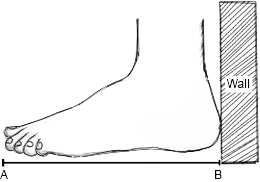
- Relax the foot and toes. Mark the paper at the longest point of the foot (you may need a helper for this).
- Draw a straight line from the wall edge of the paper to the mark, then measure this distance with a ruler. This measurement is what you’ll use to select your size.
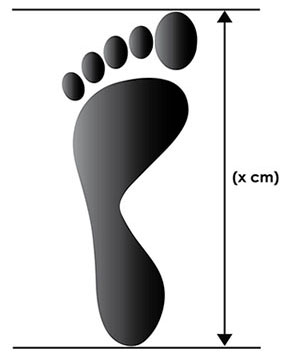
👉 Measure both feet – it’s common, especially in children, for one foot to be slightly longer than the other. We recommend ordering for the larger foot when buying jig shoes so no toes are squished.
We strongly advise not ordering based on:
-
School shoes or trainers (sizing varies widely)
-
Existing pumps or jig shoes (they stretch with wear, so the marked size is no longer accurate)
-
The old method of drawing around the foot (it’s prone to error because the result depends on the thickness of the pen and the angle you draw at)
________________________________________________________________________________________________
Step 2: Check the Size Chart
You should have two measurements, one for each foot.
If you haven't please read the 'Measure Your Feet' tab on how to do an accurate measurement.
Comparing Your Measurement to the Size Chart
Example
If your foot measures 217mm and you want to buy the Essential jig shoe:
-
Size 2 suggests a foot length of 215mm
-
Size 2.5 suggests a foot length of 218mm
If your foot measurement is close to the next size then we usually suggest choosing the size above the measurement for a good fit. So in this example the dancer would choose size 2.5.
However, some dancers may need to adjust the suggested size. If the dancer has wide feet, or is a championship level dancer then you could consider adjusting the size as below.
-
Wider feet / high instep → go up half a size. If the foot is very wide, you may need to go up a full size. (If you’ve chosen a wide-fit model, then half a size extra is usually enough.)
-
Advanced dancers → are usually looking at our more advanced models and typically know the fit they like in their preferred brand and style. Don't forget that we have already adjusted the sizing recommendations to reflect that these styles benefit from a close fitting (toes against the front leather) but some dancers prefer them even tighter, so feel free to go down half a size. We wouldn't recommend going down more than that as you risk permanently damaging your feet and damaging the shoes, shortening their lifespan.
A Word of Caution: Don’t Buy Too Large
It may seem like a safe option to order bigger, but in reality it’s a false economy:
-
Jig shoes that are too big are difficult to dance and treble in.
-
They can be a trip hazard
Step 3: Order Your Shoes
Add your chosen size to the basket.
If you’re unsure, consider ordering two sizes to compare at home, then return the pair that doesn’t fit.
Will Measuring Guarantee the Right Size?
The honest answer is no. While our method works for about 90% of dancers, the shape of each foot is unique, just like a fingerprint.
Two dancers may both measure 217mm, yet still need different sizes because:
-
One has a wide foot, bunion, or high instep
-
Another has flat feet or a narrower heel
-
They simply prefer different fits (snug for competitive dancers, comfortable for social dancers)
Tip: If your feet are unusually shaped, we recommend ordering a few sizes around your measurement. Try them at home, check with your teacher, and return the pairs that don’t fit. This saves time and postage compared with sending one pair back and forth.
________________________________________________________________________________________________
Step 4: Trying Your New Shoes On
Your order has arrived — time for the excitement (and sometimes nerves!) of trying on your new dance shoes.
We recommend lacing them up and trying them on a carpet or non-marking surface in case you need to return them. Dance a few steps, try a toe stand or treble.
Have You Got the Right Size?
Remember they will feel different to your old pair of jig shoes, especially if they are quite worn and threadbare. The most important thing to check is the length and the width. Do you have the correct amount of room for your toes? (4-5mm space for normal jig shoes, 0-4mm space for Ultralite models).
If the laces are quite far apart this is probably due to a wide foot, a high instep, or both. In these cases we would recommend going for a wide, or extra wide model.
Final Guidance
If you’re unsure about the fit, bring the shoes to class and ask your dance teacher. In many cases, teachers confirm the fit is correct.